
22/10/2026 14:07
Which Shelf Goes First? YouTube Chapters for Cambodian Shoe-Rack Shops
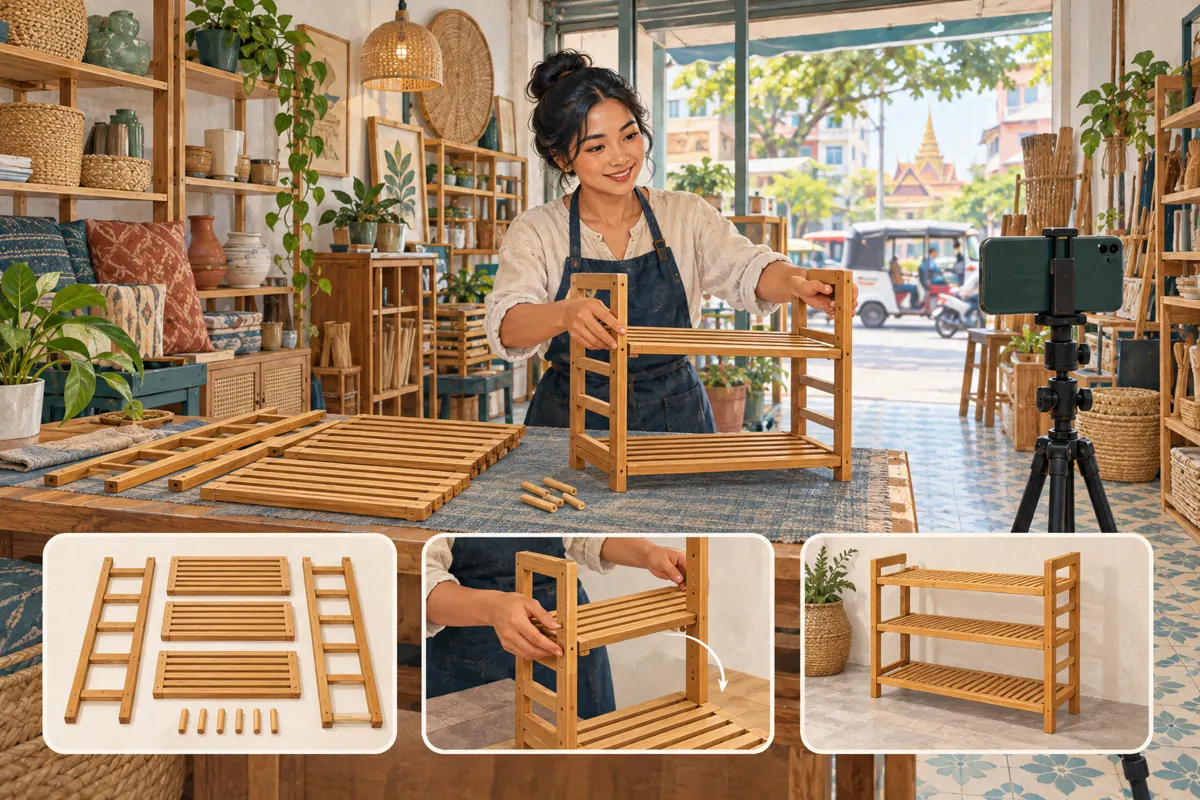
A shoe-rack assembly video can answer a customer’s question and still make the answer difficult to find. Someone checking shelf orientation may not want to replay the unpacking sequence. Another viewer may need the parts overview before deciding whether the rack suits their home. For Cambodian homewares businesses promoting demonstrations through social media, these are different viewing tasks. This guide explains how to organize one YouTube video around those tasks using chapters, test the result on a phone, and keep any SMM service discussion separate from evidence of customer understanding. The shop, product and timings in the worked example are hypothetical.
1. Choose the customer question before the chapter breaks
Start with a specific demonstration that staff already use to answer questions. A hypothetical Phnom Penh shoe-rack shop has a video showing the components, shelf orientation, assembly sequence and final checks for one model. Customers repeatedly ask which edge faces forward. The useful editorial goal is to make that explanation easy to locate, while preserving enough surrounding footage to understand it.
Write down the questions a viewer could reasonably bring to the video: Are these my parts? Which way does the shelf face? What happens before tightening? What should the completed frame look like? These questions suggest meaningful divisions. Avoid dividing the recording simply because the camera angle changes. A close-up and a wide shot may belong to the same step. Conversely, a continuous shot may contain two separate tasks that deserve different entry points.
2. Decide whether this video needs chapters
Chapters are most useful here when one demonstration serves several purposes. A prospective buyer may inspect the components, while an existing customer returns to a particular assembly stage. If the recording contains only one brief action, forcing it into several sections can make navigation less helpful. Improve the explanation itself before adding more navigation.
Review the finished edit from beginning to end and mark each change in the viewer’s task. Keep a section together when separating it would hide an essential dependency. For example, identifying the correct shelf face and showing how that face aligns with the frame may work best as one section. If two rack models require different instructions, consider separate demonstrations instead of a single chapter list that repeatedly switches products. Navigation cannot correct an ambiguous product comparison.
3. Mark boundaries on the finished recording
Use the final video, not the filming script, to record your chapter starts. An introduction removed during editing or a shortened close-up changes the location of everything that follows. Keep a simple planning note with the proposed title, start time and the first visible action. This gives another staff member something concrete to check.
Place each boundary before the explanation the viewer needs. Starting after the presenter has already identified the shelf’s front edge makes the chapter misleading even if the title is accurate. Listen to the first sentence in isolation. Pronouns such as “this,” “that one” or “the other side” may depend on earlier footage. Move the boundary back when necessary, or revise the recording if the step cannot stand alone. For an existing upload, choose the clearest available entry point rather than pretending the footage contains a complete explanation.
4. Build a practical chapter list
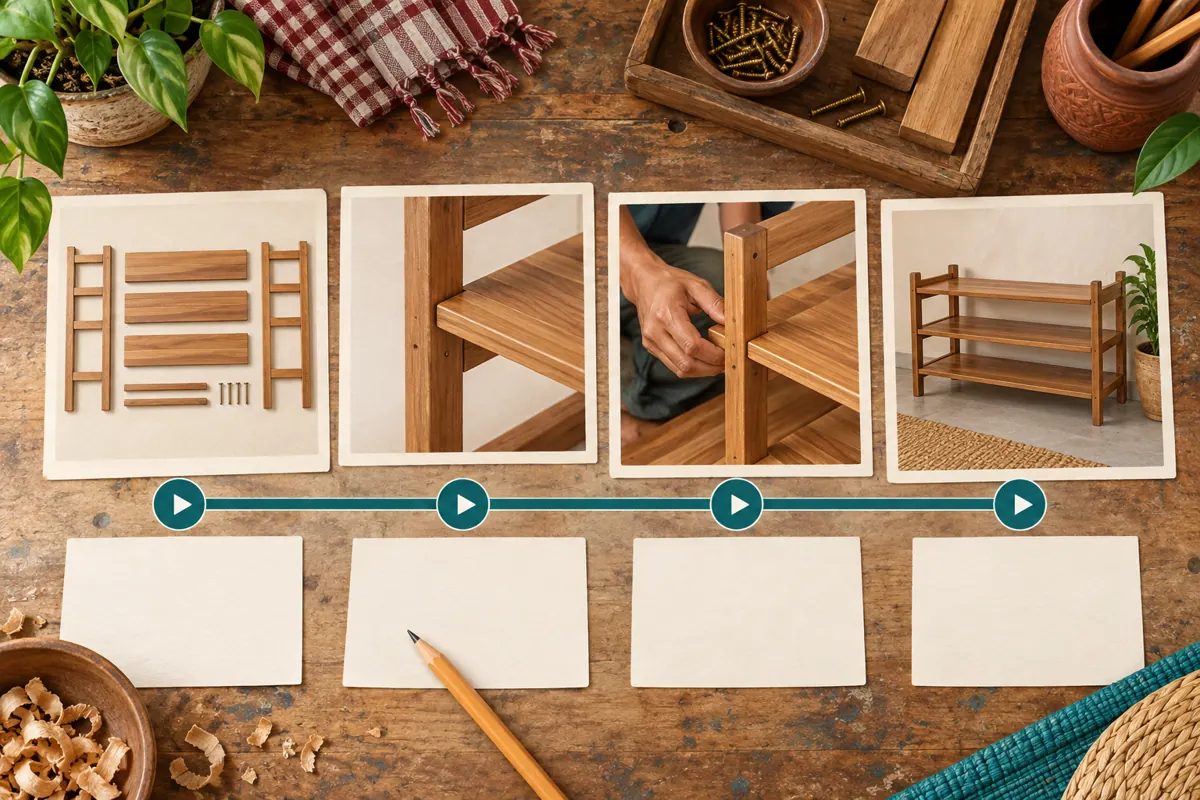
In the hypothetical example, the finished demonstration lasts six minutes and twenty seconds. A working outline could be: 00:00 Identify the rack and parts; 00:45 Check shelf orientation; 01:35 Assemble the lower section; 03:10 Fit the remaining shelves; 04:50 Check the completed frame; 05:40 Ask about missing parts. These are invented editorial timings, not instructions for a particular product. Each boundary must be checked against the actual recording before use.
YouTube’s Video Chapters guidance says manual chapters require a first timestamp of 00:00, at least three timestamps in ascending order, and a minimum chapter length of ten seconds. Add timestamps and titles in the video description through YouTube Studio, then save. Put each entry on its own line. Manual chapters override automatic chapters. If chapter access is unavailable, consult YouTube’s guidance on access to Advanced features.
5. Write labels that match the shop’s customers
Use titles that describe the action or question, such as “Check shelf orientation,” rather than “Important information” or “Amazing result.” A chapter label is a small promise about what the next part explains. Do not call a section “Fix a wobbling rack” if it only shows the finished product standing still. That mismatch sends viewers to an answer the recording never provides.
For a Cambodian shop serving mainly Khmer-speaking buyers, prepare customer-facing labels in natural Khmer and ask a fluent colleague to check the terms against the spoken demonstration. This English article’s example labels are planning examples, not a reason to change the shop’s language choices. Keep necessary model identifiers consistent with packaging and sales messages. If two languages are useful, check whether combined labels remain easy to scan on the phones your customers use, instead of adding a long translation to every title automatically.
6. Test what happens when a viewer skips ahead
Ask a colleague who did not edit the video to find the shelf-orientation explanation on a phone. Give them the customer’s question, not the answer or timestamp. Observe whether they choose the intended section and whether the opening footage makes sense. A successful test means they can explain what the section covers; it does not mean they have verified the product’s assembly method.
Check every chapter entrance, including the final section. Look for an obstructed component, an unfinished sentence or an instruction that assumes a previous step. Keep essential model-specific precautions with the relevant action and follow the manufacturer’s instructions. A chapter should never suggest that an unfamiliar viewer can safely skip prerequisites. Also check that the public video’s description and labels match the approved draft. YouTube notes that automatic chapters are not available on every video, so inspect the actual viewing experience rather than assuming automation has supplied the right structure.
7. Promote the answer people can actually find
Once the demonstration is usable, describe its practical purpose in social posts. A hypothetical caption might say that the guide shows how to identify the shelf’s front edge for the pictured rack model, with a named section for returning viewers. Avoid turning this into a universal assembly promise. Similar-looking racks may use different components, fittings or instructions.
Keep the next action relevant to the question. Someone missing a component should know what product information to provide privately to the shop. Someone comparing sizes needs a confirmed dimensions reference. A viewer watching an assembly guide is not necessarily ready to buy. Staff can share the guide when it answers a genuine enquiry, and use recurring questions to improve later recordings. Do not describe chapter navigation as a guaranteed ranking improvement, a sales mechanism or a substitute for accurate product information.

8. Review SMM catalogue language without treating it as proof
The supplied angkorsmm.com catalogue includes the exact public name “YouTube - Auto Views [RAV-MTS™ - High Monetization Views] + Engagements”. Its description field is empty. The name presents it as an automated views and engagement offering, but the brief supplies no explanation of delivery methods, audience composition or eligibility. The wording does not establish monetization benefits, official advertising delivery, Cambodian viewers or platform approval.
YouTube’s Fake engagement policy prohibits artificial increases in views and other engagement metrics and warns that a hired promoter’s actions can affect the channel. Reject methods that artificially inflate engagement; a catalogue label is not a compliance check. Purchased engagement is not evidence of genuine interest, sales, ad delivery or Cambodian users. For this workflow, useful chapter preparation can proceed without purchasing anything. If reviewing a promotion proposal, require a clear explanation of the method before considering its suitability.
9. Separate service records from customer learning
Maintain two short records if external promotion is involved. The administrative record holds the proposal or order reference, the relevant video URL, what was requested and any documented delivery information. The editorial record holds actual questions, confusing chapter labels and changes needed in the demonstration. Keeping these distinct prevents an order-status update from becoming an unsupported claim about buyers.
For example, a hypothetical staff note might say: “A customer looking for shelf orientation opened the frame-check section; rename the orientation label and test again.” That observation supports a specific editorial change. It does not establish a campaign-wide improvement. Likewise, a higher visible count does not show that viewers understood the fitting sequence. Look for direct, contextual feedback and confirmed business records when evaluating business outcomes, while acknowledging that several factors may influence an enquiry or purchase.
10. Avoid the mistakes that make chapters unreliable
Common mistakes include copying times from an earlier edit, giving every section a promotional title, hiding the model identification in the opening alone, and splitting a single explanation into tiny fragments. Another is treating the last chapter as disposable: a missing-parts section can still need enough time to explain what information staff require. Check its duration and usefulness just as carefully as the assembly sections.
Keep one approved chapter list with the video reference and review date. After any edit that changes timing, review every later boundary. After a product change, decide whether the old video still applies before promoting it again. If chapter markers do not appear, check the timestamp structure and feature access against official guidance; do not assume an SMM purchase can activate them. Assign one person to approve the final public version so that staff do not distribute different drafts as the current guide.

Frequently asked questions
Should every shelf or screw get its own chapter?
Usually that would make the list harder to scan. Group footage by the question or task it resolves. Several repeated fastening actions may belong together, while an orientation check may deserve its own section because viewers specifically return to it. Let the explanation determine the structure, rather than the number of visible parts.
Can chapters repair a demonstration that skips an assembly step?
No. A label cannot supply missing footage. If the omitted step is necessary, revise or replace the demonstration and review its references before promoting it. For a minor clarification, provide an accurate explanation in the appropriate customer guidance, but do not title a chapter as though it demonstrates something absent from the video.
Should a Cambodian shop use Khmer or English chapter titles?
Use the language that helps the intended customers identify the steps. A mainly Khmer-speaking audience may benefit from Khmer titles, with genuine product identifiers retained where necessary. Have someone familiar with both the product and language review the wording. Bilingual titles are useful only when they remain readable and resolve a real audience need.
Does a customer jumping straight to one section mean the video failed?
No. A returning customer may already understand the earlier material and need one specific explanation. Consider whether the section answered the question and preserved necessary prerequisites. Watching from beginning to end is not the only useful viewing pattern, and a quick visit alone does not reveal satisfaction or purchase intent.
What should staff do if a service provider promises that views will improve chapter visibility?
Ask for the specific official platform documentation supporting the claim. Do not accept a service title or sales message as evidence. Chapter troubleshooting belongs in a review of the video’s structure, settings and feature access. Avoid artificial engagement methods and do not spend money to solve an undocumented connection between view counts and chapter availability.
Explore the current service catalogue, create an account, or ask a specific question through support tickets.
Prepared with AI assistance. Illustrations explain the workflow and do not represent customer results.