
20/10/2026 02:11
Will the Booking Details Disappear? Telegram Auto-Delete for Cambodian Chair-Rental Shops

A social media promotion can bring someone to a rental shop’s Telegram conversation long before their event takes place. Between the first chair photo and the final collection, that conversation may contain changing quantities, delivery instructions and questions about deposits. If messages disappear before staff record the agreement, a tidy inbox can become an unreliable booking system. For Cambodian chair-rental businesses promoting through Telegram, the practical question is therefore not simply whether to enable auto-delete. It is which information may expire, which details must remain available and who will preserve them. This workflow helps answer those questions before increasing attention through social promotion or considering an SMM panel.
1. Start with the rental journey, not the timer
In a hypothetical Phnom Penh chair-rental shop, a customer enquires on Monday about a family gathering several weeks away. They first request one chair style, later change the quantity and finally arrange delivery through a relative. The conversation is useful while those decisions develop, but individual replies do not necessarily represent the final agreement. An expiry setting chosen only to reduce clutter could remove the explanation behind a change before another employee handles delivery.
Sketch the shop’s actual sequence: enquiry, availability check, quotation, confirmation, preparation, delivery, collection and resolution of outstanding questions. Beside each stage, write what the next employee needs to know. If the only answer is “scroll through Telegram,” improve the booking record before shortening message retention. Promotion should lead into a process that can preserve a customer’s confirmed requirements, including when the person who answered first is away.
2. Understand what Telegram’s timer does
Telegram’s official article, Auto-Delete, Widgets and Expiring Invite Links, explains that ordinary chat auto-delete counts from when a message is sent, rather than when it is read. Enabling it applies to subsequent messages; earlier history is not automatically swept away. That distinction matters when a customer sends instructions while the shop is closed.
A later official article, No-SIM Signup, Auto-Delete All Chats, Topics 2.0 and More, describes a global default for new conversations. Existing conversations are not changed automatically, although settings can be extended to selected chats. Review both the default and the particular conversation.
Treat expiry as an information-management choice. It does not decide whether a quotation was accepted, whether a payment arrived or whether the delivery team has understood an instruction. Those decisions still need explicit confirmation and an accessible business record.
3. Give public promotion and private booking different jobs
The public catalogue should help a prospective customer understand what the shop rents. Show chair styles, explain how to request availability and state what information is needed for an initial quotation. A private enquiry can then handle the event date, approximate quantity and delivery area. Exact residential directions and personal payment details do not belong in a public promotional discussion.
Decide separately how long each destination needs its information. A reusable chair catalogue may remain useful across many enquiries, while a conversation about an abandoned option may have little continuing value. Avoid applying one cleanup habit to every destination merely because they share an app. Before promoting a catalogue, ask a colleague to use it to start an enquiry and identify where the confirmed booking would eventually be recorded. This checks the whole customer journey rather than just whether a link opens.
4. Choose retention around the work still outstanding
For each conversation, ask whether staff still need its contents to carry out a promise. An event date in the future, an unresolved quantity change or a collection arrangement still awaiting agreement is a reason to review retention carefully. Do not choose a short interval simply because the customer usually replies quickly. Their reply speed says little about how long the rental itself will take.
In the hypothetical shop, some enquiries end without a booking, while confirmed rentals may stay active through collection. The owner chooses a policy based on those different needs and documents exceptions. The policy identifies who checks unresolved cases and where approved details belong. There is no universal duration suitable for every Cambodian rental business. If an appropriate interval is unclear, first establish the recordkeeping process and inspect the available settings instead of making an irreversible cleanup decision during a busy shift.
5. Create a booking record that staff can actually use
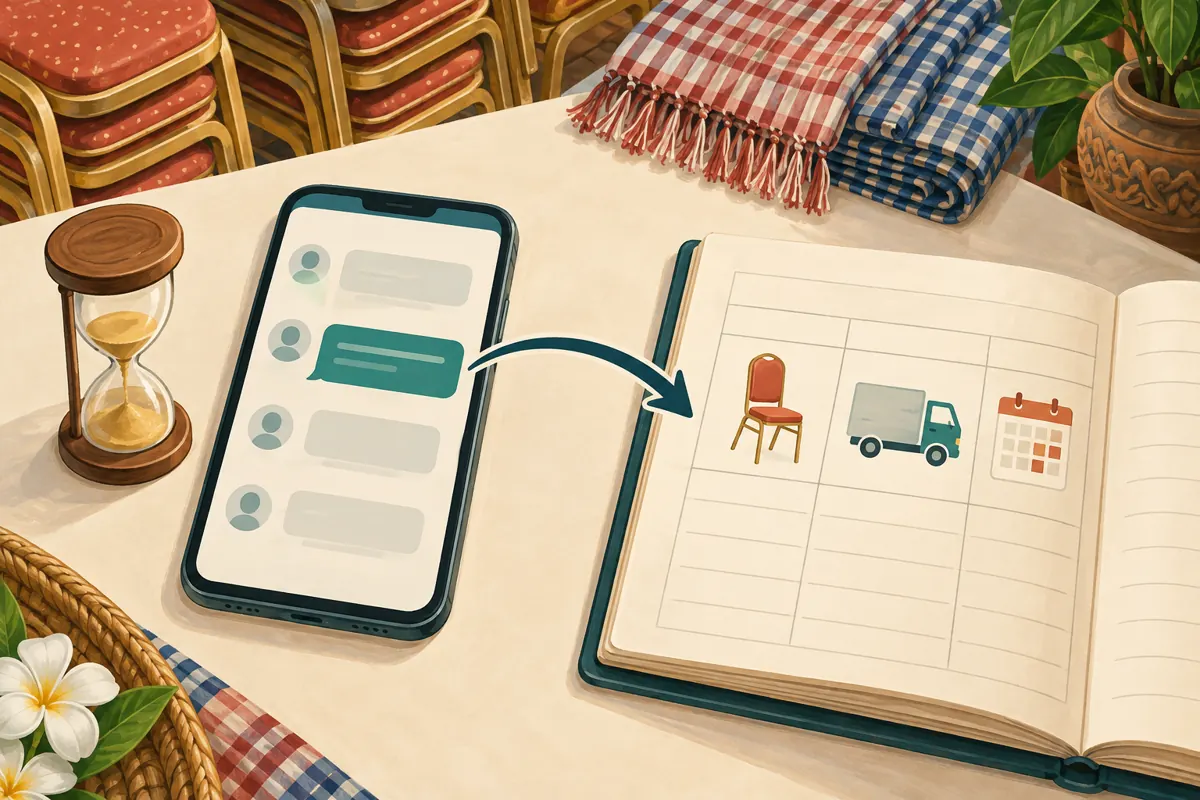
A useful booking record contains the agreed chair style, quantity, event date, delivery and collection arrangements, agreed charges with currency identified, payment status and outstanding decisions. Give it an internal reference and a responsible employee. Record only the contact and location information necessary for the work, and restrict access to the people who need it. A controlled ledger or existing booking system can serve this purpose.
Separate confirmed facts from proposals. If the customer asks whether extra chairs might be available, record that as a pending question until availability and acceptance are established. When an agreement changes, update the record and send a clear revised confirmation in the customer’s preferred language, such as Khmer. Let the customer check it before preparation begins. Avoid copying entire conversations indiscriminately: the aim is an accurate operational record, with any necessary supporting evidence, rather than another disorganised archive.
6. Inspect settings carefully and test with harmless messages
Telegram documents the global control under Settings, Privacy & Security, Auto-Delete Messages. Inspect that setting first, then inspect the relevant conversation’s auto-delete controls. Labels and menu placement can differ between app versions. Read the scope shown on the confirmation screen before accepting a change, especially when an option offers to apply settings to additional conversations.
Use a consenting colleague and an empty test conversation before experimenting around live bookings. Send clearly disposable content, inspect the displayed expiry information and note what each participant sees. Check that staff can distinguish changing a timer from manually deleting history. Do not use a customer’s address, payment evidence or active quotation as test material.
If the test duration extends beyond the current shift, assign a later check. Record the observed result before treating the setup as verified. Testing should establish what happens in the app your team uses, without risking information needed for tomorrow’s delivery.
7. Explain the process before a customer relies on the chat
Give customers a short, accurate explanation when conversations are temporary. A hypothetical shop might say: “We use this chat for enquiries. When your rental is confirmed, we will send a booking summary. Please check the chair type, quantity, delivery and collection details, and keep your confirmation.” If the shop retains booking information elsewhere, its explanation should reflect that practice rather than promising that everything disappears.
Avoid making a privacy promise broader than the shop can support. A disappearing message does not establish that no participant has retained its contents elsewhere. Likewise, telling someone to keep a confirmation is insufficient if the confirmation never arrives or omits a last-minute change. Assign the employee handling the enquiry to check both delivery of the summary and any customer corrections. This turns a vague warning about temporary messages into a usable customer-service step.

8. Put the SMM panel decision after the enquiry check
The supplied angkorsmm.com catalogue includes the exact service name “Telegram - Channel/Group Members ~ 𝗥𝗘𝗙𝗜𝗟𝗟 30D ~ 10k/days ~ INSTANT”. Its title identifies a channel/group member service. The brief supplies no supporting description, so the title’s speed and refill wording should not be treated here as verified delivery commitments. It also provides no basis for claiming Cambodian participants, genuine rental interest or sales.
A member service does not configure message expiry, preserve a quotation or confirm a reservation. Purchased engagement is not evidence of genuine interest, ad delivery, Cambodian users or business results. Before considering a request, confirm the current service requirements and applicable platform rules, and decide whether the service fits a legitimate objective. Keep any panel delivery record separate from enquiries and completed rentals. If the booking process still loses instructions, improve that process first; additional visible activity cannot repair missing operational information.
9. Avoid shortcuts that create missing context
One common mistake is assuming the latest visible reply contains the whole agreement. “Yes, that is fine” may refer to a quantity, a delivery time or a different chair style. Write the accepted details together rather than preserving only the reply. Another mistake is delaying record updates until the end of a busy week. Update confirmed changes when they happen, while the context is still available.
Do not guess if an important instruction has already disappeared. Mark the affected field as unconfirmed, check the authorised booking record and ask the customer to reconfirm any unresolved detail. Explain the uncertainty plainly. A second shortcut is relying on a personal phone screenshot that other staff cannot access when needed. Use the shop’s agreed record location and protect sensitive information. A third is treating message disappearance as cancellation: a booking remains an operational matter that requires an explicit status decision.
10. Review whether the workflow survives a staff handover
After introducing the process, review a small selection of completed and still-open rentals. Ask a colleague who did not handle the enquiry to find the confirmed chair style, delivery arrangement and latest approved change. If they must reconstruct the agreement from scattered messages, revise the record template or responsibility assignment. The test is whether another employee can fulfil the booking accurately.
Track practical problems such as missing confirmations, repeated requests for directions and unresolved changes reaching the delivery team. Keep those observations distinct from channel membership or panel order status. When a problem appears, identify its cause: an unsuitable expiry setting, a missed update or an ambiguous confirmation. Adjust that specific step, then check it during the next handover. This gives the shop a more dependable foundation for promotion without attributing improvements to purchased activity or claiming that message settings create demand.

Frequently asked questions
Should every rental enquiry use the same auto-delete interval?
Not necessarily. A brief availability question and a confirmed rental with future delivery have different operational needs. Establish a consistent policy, but allow documented exceptions where staff still need information. Consistency means applying a clear decision rule, not forcing every conversation into the shortest available duration.
Can we enable auto-delete to remove all old quotations?
Enabling the timer does not automatically remove earlier messages, according to Telegram’s documentation. Review old quotations separately and check whether they support an active booking or unresolved question before considering deletion. Do not combine a settings experiment with a large cleanup of business history.
What if a customer changes the delivery location near the event?
Check the new location and any effect on the agreed service, update the booking record and send a revised confirmation. Notify the employee responsible for delivery through the shop’s established process. Leave the change marked as pending if an important detail or additional charge has not been agreed.
Does saving a booking summary defeat the purpose of temporary chats?
A focused booking summary can preserve necessary operational facts while avoiding indefinite retention of every conversational detail. Be clear about what the shop keeps, why it keeps it and who can access it. Do not describe the conversation as leaving no records if the shop maintains a separate booking record.
Will a Telegram member service bring more rental customers?
The supplied service information does not establish that outcome. Member delivery cannot demonstrate Cambodian location, genuine interest or completed bookings. Judge rental demand through actual enquiries, confirmed requirements and completed transactions, while keeping any SMM order information in its own record.
Explore the current service catalogue, create an account, or ask a specific question through support tickets.
- Telegram: Auto-Delete, Widgets and Expiring Invite Links
- Telegram: No-SIM Signup, Auto-Delete All Chats, Topics 2.0 and More
Prepared with AI assistance. Illustrations explain the workflow and do not represent customer results.